

Jealousy can show up when a friend starts a relationship, a colleague gets an opportunity or a partner spends time elsewhere. You may feel afraid of being replaced, disappointed about something you want or unsure where you stand. Having the feeling does not make you a bad person.
The useful question is what you do next. You can take the feeling seriously without treating every fear as a fact or making someone else responsible for removing it.
On this page
Name the feeling and the situation
Try a plain description: “I feel jealous because my friend has less time for me,” or “I wanted that promotion, and seeing someone else get it hurts.” Naming the particular loss or worry gives you something more workable than deciding you are simply a jealous person.
Envy of someone else’s opportunity and fear of losing a relationship may need different responses. A career disappointment might call for feedback or a new plan. Missing a friend might call for an invitation. Neither requires making the other person’s good news into a wrongdoing.
Separate observations from assumptions
Write two short lines if that helps: what happened, and what you concluded. “They went out with friends” is an observation. “They don’t care about me anymore” is an interpretation. There may be information you do not have.
A trusted person can help you think through the situation. Ask for perspective rather than asking them to investigate, contact your partner or confirm an accusation. Share only the private details needed to explain your concern.
A fairer thought does not need to be cheerful. “I don’t know what this means yet, and I can ask about our plans” may be more credible than “Everything is perfect.” The NHS describes checking evidence and considering other explanations as one way to respond more flexibly to unhelpful thoughts.
Comparison also leaves out information. A photograph, promotion announcement or couple’s happy evening does not show their whole life. You can acknowledge wanting something similar without judging your own life by a small public snapshot.
Appreciating something you have is optional, not a duty that cancels disappointment. You can be grateful for a friendship and still miss how much time you used to spend together.
Pause before you act
If you are about to send an accusatory message, check a phone or confront someone publicly, pause. Put the device down, leave the conversation safely for a while or draft a message without sending it. Return when you can describe the concern without threats or insults.
A pause is a way to choose your behaviour, not a demand that the emotion disappear. Choose a manageable action such as getting a drink, walking somewhere suitable or calling a supportive friend. Avoid using silence as punishment or a test of whether someone will chase you.
Ask for what you need without controlling
Make a specific request that leaves room for an answer: “I’d like some time together this week. Could we choose an evening?” If you are unsure about exclusivity, ask about that agreement directly. Do not rely on secret tests or assume you share the same expectations.
Privacy and ordinary independence still matter. Demanding passwords, tracking someone’s movements or deciding who they may speak to is not a useful reassurance plan. If you crossed a limit, acknowledge what you did and stop it; your feeling does not remove your responsibility.
On the other hand, do not use “I’m just jealous” to dismiss a clear broken agreement or another person’s intimidation. Describe the actual behaviour and consider what you need. Where a conversation feels unsafe, individual support may be more appropriate than confronting the person.
You may need more than one conversation, or you may discover that your expectations differ. There is no fixed deadline for feeling secure. Notice whether the arrangement works for you and whether both people can discuss it respectfully.
Get support when the pattern keeps returning
If repeated checking, arguments or distress are affecting daily life, a qualified mental-health professional can help you examine what is happening and consider ways to respond. You do not need to diagnose yourself before asking for help.
If you are worried you may hurt someone, create safe physical distance, avoid confrontation and seek urgent support; contact local emergency services if there is immediate danger. Take responsibility for getting help instead of asking the other person to prevent your actions.
Progress may mean noticing the feeling earlier, making one clearer request or deciding not to check a device. Those choices matter even when jealousy has not completely gone away.
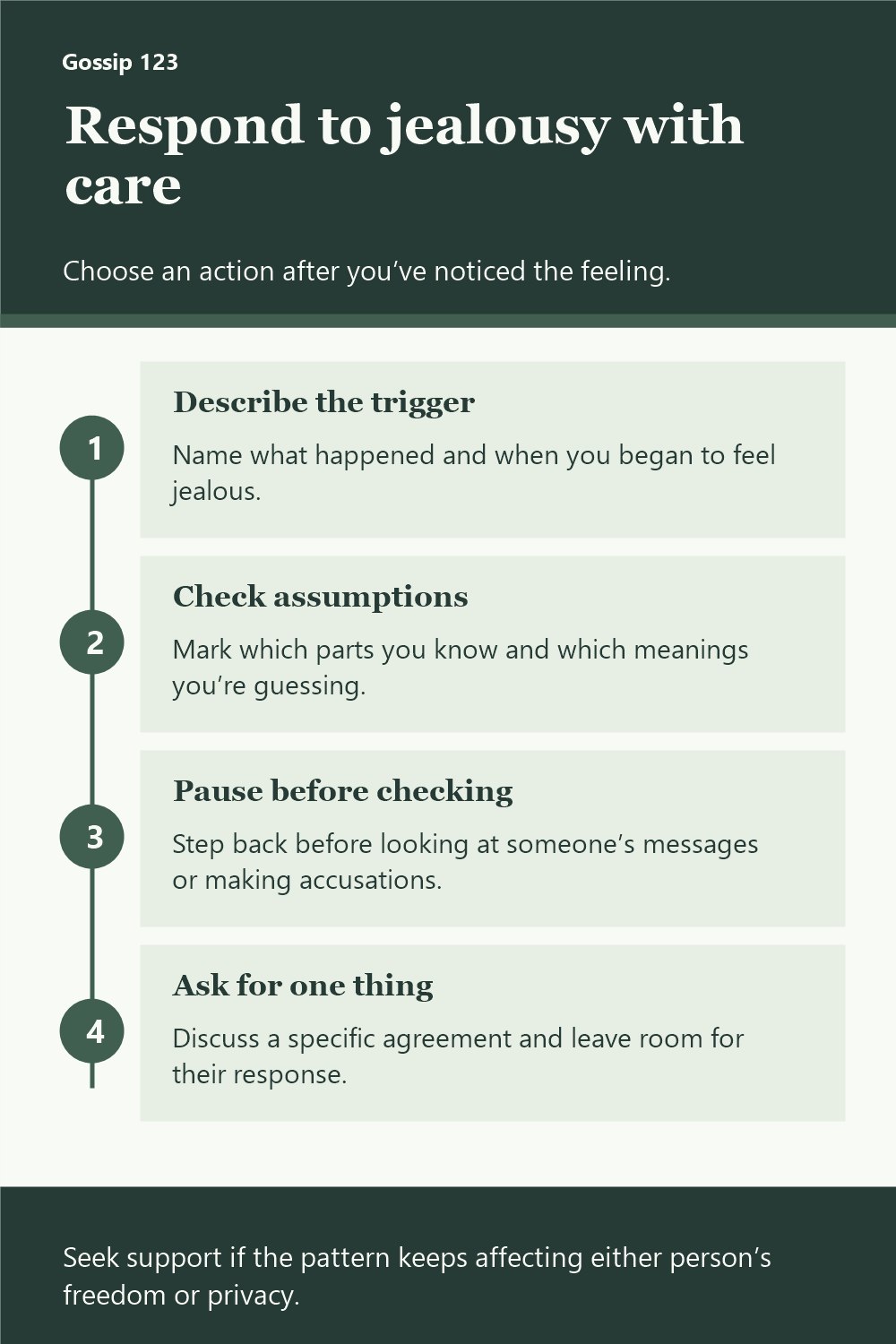
Read the infographic in text
Respond to jealousy with care Choose an action after you’ve noticed the feeling.
- Describe the trigger Name what happened and when you began to feel jealous.
- Check assumptions Mark which parts you know and which meanings you’re guessing.
- Pause before checking Step back before looking at someone’s messages or making accusations.
- Ask for one thing Discuss a specific agreement and leave room for their response.
Seek support if the pattern keeps affecting either person’s freedom or privacy.