

People sometimes use “inner demons” to describe fears, regrets or thoughts they find difficult to share. If that phrase fits your experience, you can explore what it means to you. If it makes you feel ashamed or frightened, use a more specific description of what is troubling you.
You do not have to fight every feeling or prove that you are strong enough to handle it alone. Start with one concern and the kind of support or practical change that would help you through today.
On this page
Give the concern a clearer name
Try completing a concrete sentence: “I keep worrying about tomorrow’s conversation,” “I regret what I said to my friend,” or “I have too many tasks and do not know where to begin.” You can describe the problem without judging your whole character.
A thought about what might happen is different from an event you know has happened. Write down the facts you have and the questions that remain. You do not need to treat every feared outcome as something you must solve immediately.
If you regret a particular action, ask whether a correction is possible. If you are frightened by someone else’s behaviour, consider what support or protection you need. These concerns deserve different responses rather than one instruction to change your mindset.
Notice the situation around it
Look at when the concern becomes harder to manage. Is it after an upsetting conversation, while checking messages late at night or when several demands arrive at once? A short note can help you see a pattern without turning your whole day into a monitoring exercise.
Consider practical pressures too: a task without clear instructions, a responsibility that needs sharing or a request you cannot meet. Some problems need information, a change of arrangement or another person’s help.
You do not need a perfect explanation before making the situation more manageable. You might move a difficult conversation to a better time or ask someone to clarify what is actually required.
Choose one response you can manage
Match the response to the concern rather than trying every self-improvement idea at once. Ask what is within your control and what can wait.
- For an unclear task, write down the first question you need answered.
- For a crowded day, choose one priority and reconsider an optional commitment.
- For an upsetting message, pause before replying and ask whether a response is needed now.
- For a mistake, consider one specific repair instead of making a sweeping promise.
Rest or a familiar activity can also be part of the next step. You do not have to earn a pause by resolving every concern first. If a proposed exercise makes you more distressed, stop and choose another form of support.
Share at a pace that feels appropriate
Choose someone who can listen respectfully and ask whether they have time for a conversation. You can say: “I don’t need you to solve this, but could you help me sort out what happened?” A specific request gives the listener a clearer role.
You can keep details private. Share enough to receive the help you want without feeling obliged to disclose everything to a friend, online group or person you have just met. Consider who may see anything you post.
If another person’s pressure is part of the problem, our guide to responding when people cross your boundaries offers ways to think about limits and support. Better wording cannot make someone else respect your choices.
Find more support when you need it
If distress persists, worsens or interferes with sleep, concentration or everyday activities, consider speaking with a qualified health professional. The National Institute of Mental Health’s help guide can help you consider when to seek care. You do not need to wait until you can explain the cause clearly.
Spiritual reflection, prayer or a trusted community may matter to you too. You can include those sources of comfort while getting practical or professional support. You do not have to interpret distress as a personal or spiritual failure.
Review the next step by whether it is useful and manageable. Asking for help, changing an unrealistic plan or acknowledging that something is difficult can be a meaningful response in itself.
Read the infographic in text
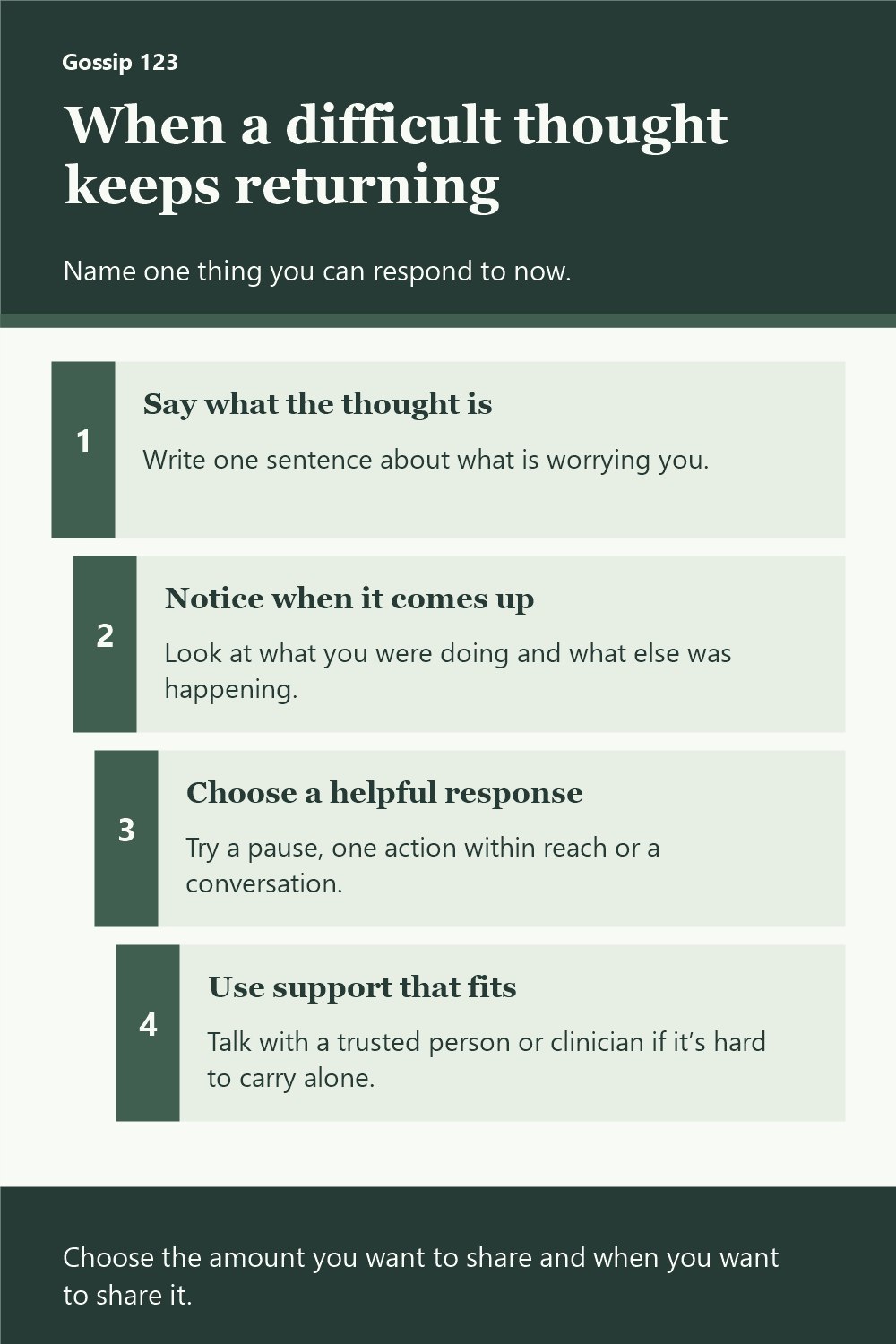
When a difficult thought keeps returning Name one thing you can respond to now.
- Say what the thought is Write one sentence about what is worrying you.
- Notice when it comes up Look at what you were doing and what else was happening.
- Choose a helpful response Try a pause, one action within reach or a conversation.
- Use support that fits Talk with a trusted person or clinician if it’s hard to carry alone.
Choose the amount you want to share and when you want to share it.