

Workplace gossip can range from an unverified story to repeated comments that damage someone’s reputation or make it harder to do their job. You do not have to laugh it off, join in or confront a colleague before you can ask for support.
A useful response depends on what happened, how serious it is and what feels safe in your workplace. Start with the information you actually have, limit further sharing and choose a next step that addresses the behaviour rather than spreading the story to more people.
On this page
Identify the behaviour and its effect
Ask what was said or shared, who directly heard it and what you know first-hand. “A colleague told me that a rumour is circulating” is different from “I received this message in the team chat.” Keep that distinction when you describe the situation.
Consider the effect too. Is private information being discussed? Has a false claim reached someone who makes decisions about your work? Are you being excluded, mocked or pressured to explain personal matters? A pattern and its practical consequences can be more useful to describe than a label such as “toxic office.”
Ordinary work feedback is different from discussing a person’s private life or humiliating them. If a concern is about someone’s performance or safety, it can be raised with the appropriate person through an agreed work process. It does not need to become a group conversation about their character.
Interrupt a conversation without escalating it
If you hear a rumour, you can decline to pass it on. A brief response may be enough:
- “I do not know whether that is true, so I am not going to repeat it.”
- “That sounds private. Let’s leave it with the person involved.”
- “If there is a work concern, who is the right person to raise it with?”
Then return to the task or leave the conversation when practical. You do not need a clever comeback or a public argument. If someone asks you about a rumour concerning you, a limited correction can help: “That information is inaccurate. Please do not share it.” You can choose how much personal detail to disclose.
A private conversation with the person involved is one option if you feel comfortable and think it could help. Describe the behaviour and make a clear request to stop. You can also choose a manager, representative or other support route instead, especially if there is a power imbalance, a repeated pattern or concern about retaliation.
Keep a useful, factual record
If the behaviour continues or affects your work, keep a short record that separates events from interpretations. Include the date, the setting, what you directly observed, any witnesses and what effect it had. Note when information came from someone else rather than presenting it as something you heard yourself.
Keep relevant messages you have received and follow your workplace’s rules for handling confidential information. Avoid circulating screenshots to colleagues, moving sensitive material to an unsuitable personal account or gathering private information that you are not entitled to access. Ask the appropriate support person how to provide evidence securely.
You do not need to become an investigator. One clear example can be a starting point for explaining a concern. If you do not have witnesses, you can still describe what happened and ask what the next step should be.
Choose an appropriate support route
Check the relevant workplace policy if one is available. It may explain who handles concerns about conduct, bullying, harassment or confidentiality. Depending on your workplace, you might approach a manager, another manager, HR or a union representative. If your usual contact is involved in the problem, look for an alternative named route.
Acas’s guidance on workplace bullying discusses keeping records and getting support, including alternatives to speaking directly with the person. Its guide to raising a workplace problem also explains informal and formal routes. These resources concern workplaces in Great Britain; use an appropriate local service for advice about your own situation.
Describe the behaviour, give a relevant example and explain what you want help with. You might ask how to correct false work information, stop private details being shared or understand the reporting process. Ask who will receive the information and what confidentiality can realistically be offered. Do not assume a conversation will stay entirely private.
You do not have to resolve a serious concern through a direct confrontation first. If there are threats or an immediate safety concern, use the appropriate urgent workplace or emergency support route.
Follow up and protect your working day
After raising the issue, record what was agreed and when you should expect an update. If the behaviour continues, describe the new incident through the agreed route rather than restarting the story around the office. Ask what other options exist if the first approach has not helped.
Meanwhile, choose practical limits on how much of your day the rumour occupies. You might check in with one trusted person, turn off a distracting chat notification when your work allows it or ask for help with a task affected by the situation. If your employer offers an employee assistance programme, you can ask what support is available.
If you repeated a rumour yourself, stop sharing it and correct it with the people you told without adding more private detail. Acknowledge your part plainly. Your next step can reduce the spread even when you cannot control what everyone else says.
Read the infographic in text
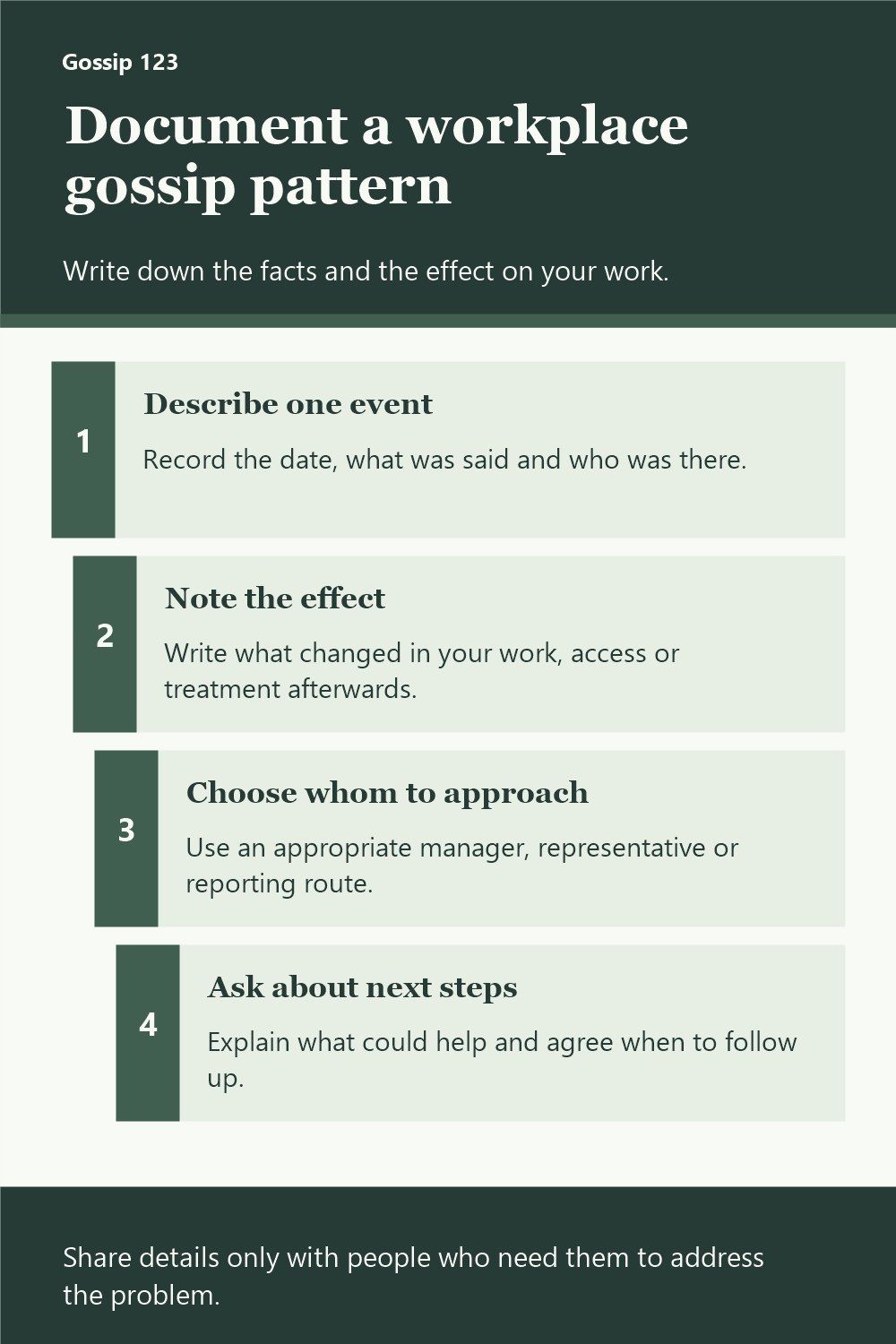
Document a workplace gossip pattern Write down the facts and the effect on your work.
- Describe one event Record the date, what was said and who was there.
- Note the effect Write what changed in your work, access or treatment afterwards.
- Choose whom to approach Use an appropriate manager, representative or reporting route.
- Ask about next steps Explain what could help and agree when to follow up.
Share details only with people who need them to address the problem.