

A relationship can develop slowly and still offer clear communication and care. It can also feel enjoyable without becoming the partnership you want. The pace alone cannot tell you which situation you are in, and neither can a meeting with friends, a romantic weekend or plans made far ahead.
Instead of trying to classify the relationship from clues, consider what each of you has actually agreed to and whether that arrangement works for you. You can ask for clarity without demanding a promise about the future.
On this page
Separate the pace from the agreement
“Taking it slowly” can mean different things: seeing each other less often, waiting before physical intimacy, getting to know each other’s routines or postponing a decision about commitment. Someone may want a committed relationship while moving carefully. Someone else may want occasional dates without a future partnership.
Those are different arrangements, even if both people use the same phrase. Ask what slow means in everyday terms rather than assuming it describes the same goal.
You might say, “I enjoy seeing you, and I would like to understand what you are looking for. When you say you want to take things slowly, what would that look like over the next few weeks?” Make room for an answer you may not prefer.
Ask questions that need specific answers
Choose a time when you can both pay attention, if talking feels safe. Start with the issue that matters most to you rather than presenting a long list of tests. Useful questions include:
- Are we dating other people, or have we agreed to be exclusive?
- What kind of contact and time together are we each comfortable with?
- Are we both interested in exploring a committed relationship?
- What information about us is okay to share with other people?
Being affectionate does not establish exclusivity. A label may also mean different things to each person, so discuss the practical expectations behind it. Consent to one kind of intimacy never creates an obligation to another.
If the answer is “I don’t know,” you can ask what the person does know now. You do not need to extract certainty they cannot offer, but you are allowed to consider how much uncertainty you want to live with.
Notice what happens after the conversation
Look at whether ordinary behaviour matches the agreement. Do you both make plans, follow through or explain changes? Can either person express a preference or decline something without punishment? When a misunderstanding happens, is there room to discuss it and make a workable adjustment?
These questions concern how the relationship functions now. They cannot guarantee that it will last. Big future plans or a strong spark are not substitutes for respectful treatment today.
Family introductions may matter to you, but people have different circumstances around privacy, culture and family safety. An introduction alone cannot establish commitment, and a delay alone cannot prove that someone is hiding you. Ask about the situation without insisting on access to private information.
Keep your boundaries and your own life
You do not have to put a partner ahead of every other need to show that your feelings are serious. Keep space for friends, rest, work, interests and decisions that belong to you.
Explain what you can offer and what you need. For example: “I am comfortable getting to know each other gradually, but I only want to continue dating if we are exclusive.” The other person can decline. Your next choice is whether to continue, rather than trying to make them agree.
The love is respect guide to boundaries and expectations offers more detail on discussing limits. If saying no brings threats, monitoring or pressure, seek support from someone you trust or a specialist relationship-abuse service. You do not owe a confrontation that puts you at risk.
Choose what you can accept now
If you both want to continue, agree on a manageable next step and a time to check in. That might mean planning another date and revisiting the conversation after a few weeks. A check-in creates a chance to talk; it is not a deadline for producing particular feelings.
If your wishes differ, neither person has to be dishonest for the relationship to be unsuitable. You can care about someone and decide that the available arrangement does not meet your needs. You can also change your mind about continuing.
Ask yourself: “If things stayed as they are for now, would I freely choose this?” Use the answer alongside what the person has told you and how you are treated. You do not have to prove that a relationship is shallow before deciding to step back.
Read the infographic in text
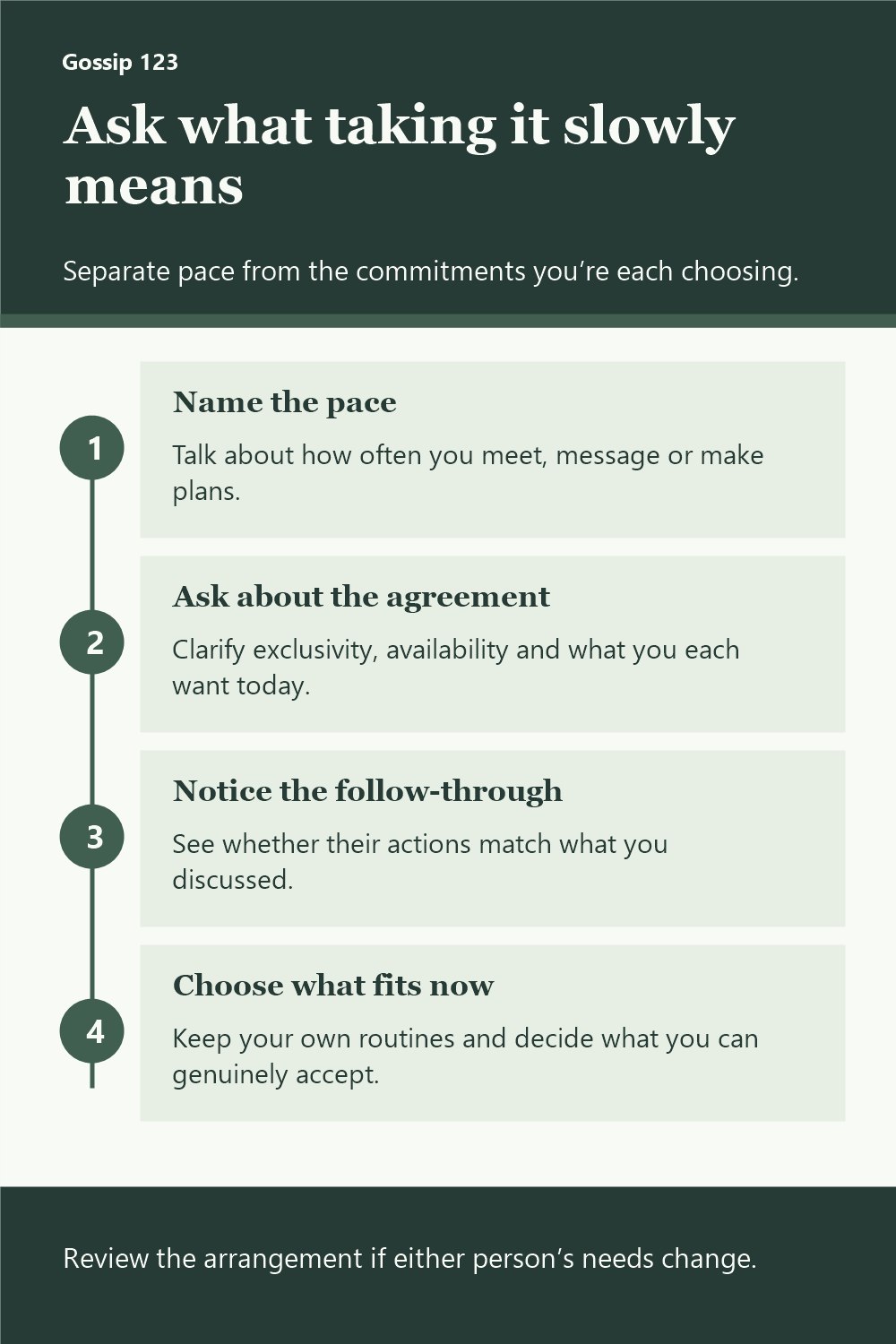
Ask what taking it slowly means Separate pace from the commitments you’re each choosing.
- Name the pace Talk about how often you meet, message or make plans.
- Ask about the agreement Clarify exclusivity, availability and what you each want today.
- Notice the follow-through See whether their actions match what you discussed.
- Choose what fits now Keep your own routines and decide what you can genuinely accept.
Review the arrangement if either person’s needs change.