

A conversation about someone who is absent can serve different purposes. You might be asking for support, arranging help or passing on information they wanted shared. It can also become an exchange of rumours, private details or guesses that the person has no chance to correct.
The useful question is not simply whether the story sounds positive or negative. Consider why you are sharing it, whether you know it is accurate, who needs the information and whose privacy is involved. You can change a conversation without labelling yourself or anyone else as addicted to gossip.
On this page
1. Check the purpose before sharing
Pause before repeating a story and ask, “What will sharing this do?” Passing on a friend’s public invitation is different from describing their private disagreement to entertain a group. A story does not become yours to distribute just because someone else has already repeated it.
Check what you actually know. Did you observe the event, hear it directly from the person or receive a second-hand account? Separate those categories. “They have not replied to me” is an observation; “They must be having an affair” is an interpretation that should not be passed along as fact.
Permission matters even when the news seems happy. Someone may want to announce their own pregnancy, relationship, recovery or new job. If you are unsure, ask: “Is this something you want me to share, and with whom?” Leave the detail private until you know.
2. Separate support from spreading a rumour
You are allowed to seek help about your own experience. Talking with a trusted person or an appropriate professional about mistreatment is not automatically harmful gossip. A rule that says you must only speak positively about others should not stop you from asking for support or reporting a serious concern.
Choose the listener and the detail for the purpose. If you need advice about a difficult conversation, you may be able to explain the issue without sharing unrelated health information, intimate messages or identifying details about other people. Ask the listener to avoid passing the account on.
Do not assume that a designated “gossip buddy” makes every disclosure harmless. Another person’s private information remains private, and a friend cannot guarantee that a story will never travel further. Share what is needed for support rather than treating a confidential audience as permission to repeat everything.
3. Redirect a conversation in plain words
You can decline without giving a speech. Try, “I do not know whether that is true,” “I would rather let them share their own news,” or “Can we talk about something else?” A simple response may fit better than arguing about whether everyone in the group has good intentions.
Offer another topic if you want to stay in the conversation. Ask about an upcoming event, a shared interest or something the people present have chosen to discuss about themselves. Connection does not have to depend on revealing someone else’s difficulties.
Online, the pause can happen before forwarding a screenshot, tagging someone or adding a reaction that encourages the thread. You can stop contributing, mute a discussion or leave a group. If there is a threat or harassment, consider the platform’s reporting options and appropriate support rather than getting drawn into a public exchange.
4. Repair what you shared
If you repeated something inaccurate, correct it with the people you told: “I passed that on without knowing it was true. I should not have presented it as fact. Please do not repeat it.” Keep the correction clear, without retelling the whole story to a larger audience.
If you disclosed private information, acknowledge that directly to the person affected where appropriate: “I shared something you told me in confidence. That was my choice, and I am sorry.” Explain the steps you have taken to limit further sharing, while being honest about what you cannot undo.
Ask what would be useful now, and accept that they may need space or change what they share with you. An apology is not a demand for immediate trust. A practical change might be checking permission before sharing news or pausing before sending screenshots.
5. Respond when you are the subject
You do not have to answer every rumour publicly. Consider who needs accurate information and what you are comfortable disclosing. A brief correction may be enough: “That account is inaccurate. I am not discussing the private details.” You can set a limit without making your entire life available for inspection.
If the situation affects your work, education or safety, keep an accurate record when it is safe and seek help through an appropriate person or reporting channel. Describe specific messages or events rather than guessing motives. If you are in immediate danger, seek local emergency help when you can safely do so.
You can also ask a friend for company or practical support without recruiting them to retaliate. The aim can be to reduce further sharing, correct what needs correcting and protect your choices about privacy. You do not need to solve the whole situation in one conversation.
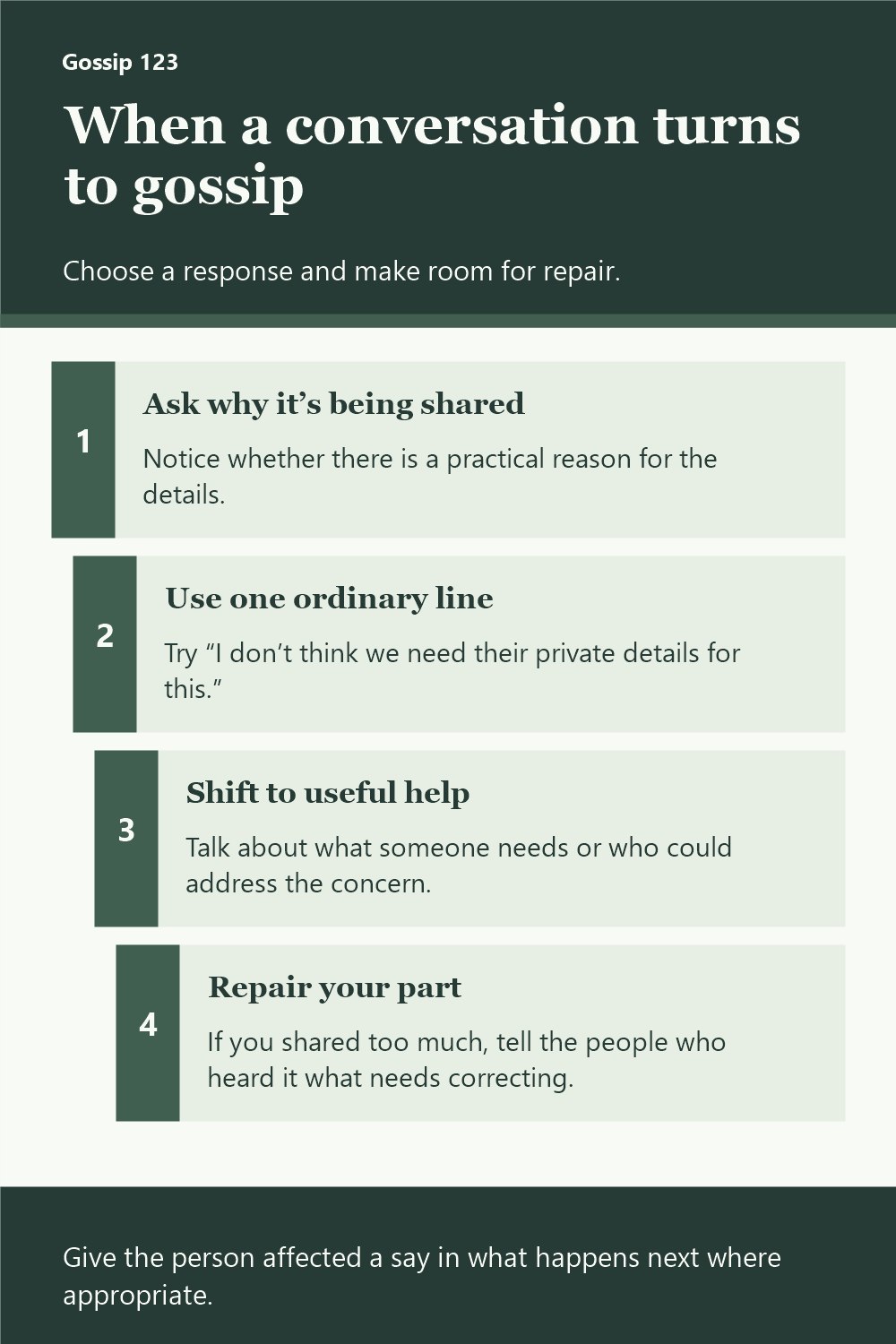
Read the infographic in text
When a conversation turns to gossip Choose a response and make room for repair.
- Ask why it’s being shared Notice whether there is a practical reason for the details.
- Use one ordinary line Try “I don’t think we need their private details for this.”
- Shift to useful help Talk about what someone needs or who could address the concern.
- Repair your part If you shared too much, tell the people who heard it what needs correcting.
Give the person affected a say in what happens next where appropriate.