

Wanting regular contact with a partner does not make you “clingy.” Wanting an evening alone does not make someone uncaring. The useful question is whether you can discuss closeness and space in a way that leaves both people room to choose.
Instead of trying to look perfectly independent, make the practical arrangements clearer: when you will see each other, what contact you enjoy and how you will handle changed plans. You can express a need early in dating; you do not have to hide every concern until the relationship is established.
On this page
- Notice the feeling before choosing an action
- Ask about relevant history with care
- Agree on personal time
- Keep connections outside the relationship
- Make plans that fit your actual lives
- Discuss contact without demanding availability
- Handle requests and refusals respectfully
- Review whether the arrangement works for you
1. Notice the feeling before choosing an action
You may feel jealous, disappointed or unsettled when you want more time together than your partner does. A feeling can draw attention to something you value without proving that someone has rejected you or broken an agreement.
Try naming the immediate situation: “I was looking forward to tonight, and now I feel disappointed.” Then choose what you want to do with that information. You might ask to rearrange the plan, make another invitation or give yourself time before discussing it.
If comparison or jealousy is becoming the main concern, our guide to understanding jealousy and choosing a response explores the difference between an observation, an interpretation and an action. You do not need to become emotionless to have a respectful conversation.
2. Ask about relevant history with care
Asking about a partner’s past is not automatically a sign of insecurity. Previous commitments, co-parenting arrangements or experiences someone chooses to share may help you understand their present life.
Consider why you want to know. “Are there existing commitments that affect when we can meet?” has a practical purpose. Repeatedly asking whom they found more attractive may leave both people in a comparison neither can settle.
The other person can keep private details private. You can also explain what information matters for your choices, including current relationship agreements or sexual-health conversations. If essential information is unavailable, decide what you are comfortable choosing with that uncertainty rather than pressuring someone into disclosure.
3. Agree on personal time
Personal time works better when it is discussed as part of ordinary life. You might want an afternoon for a project, a quiet journey home or time to rest after work. A partner may want something different.
The Mental Health Foundation’s relationship guidance recommends discussing and respecting boundaries, including time alone, and listening to understand each other’s perspective.
Be clear enough to prevent avoidable confusion: “I want to spend tonight on my own. I would like to see you on Saturday.” Offer the second part only if you mean it. Space should not become a silent test in which someone is expected to chase, guess or earn contact.
4. Keep connections outside the relationship
You can enjoy a close relationship while keeping friends, family contact and interests that matter to you. This does not require an impressive social calendar or an identical number of evenings apart.
If you have been cancelling a valued connection whenever your partner is available, try protecting one existing plan. “I am meeting my friend on Thursday; let’s choose another evening for us” communicates an arrangement without asking permission to maintain a friendship.
Work, disability, caring responsibilities or limited money may restrict the options available. A short call or shared activity at home can still matter. If you want ideas for comfortable personal time alongside connection, Learn to Enjoy Being Alone offers flexible starting points.
5. Make plans that fit your actual lives
Look at the week you really have. Discuss work shifts, rest, travel and any shared responsibilities before assuming that every free hour is couple time. Neither person should have to remain permanently available in case the other wants company.
- Choose a plan you both want, with a realistic time and place.
- Agree how you will let each other know if it changes.
- Keep responsibility for the arrangements clear, including any care tasks that need covering.
For example: “Let’s have dinner on Tuesday. If either of us is working late, we will send a message when we know and choose another time.” The agreement is useful because it describes an action, rather than requiring either person never to feel disappointed.
6. Discuss contact without demanding availability
People differ in how often they enjoy texting or calling. There is no universal reply time that proves love, and a delayed message does not tell you everything about someone’s intentions.
Ask what contact is workable: “I enjoy a short call when we are away. Would a call after dinner suit you?” The answer may be an alternative or a refusal. Listen to what the person can actually offer before deciding whether it meets your needs.
Distinguish a planning message from reassurance about the relationship. If repeated checking is taking over your day, our reassurance guide explores clearer requests, pauses and support beyond a partner. You can work on an intrusive habit without deciding that your need for connection is shameful.
7. Handle requests and refusals respectfully
A request leaves room for a real answer. “Could we spend more time together?” starts a discussion. Threatening to end a friendship, demanding passwords or tracking a partner’s location to force closeness crosses a different line.
If you have pushed past a refusal, acknowledge the behaviour and stop it. “I sent several messages after you asked for quiet. I will give you the space you requested” takes responsibility without asking the other person to comfort you first.
The same consideration applies to you. Being called “clingy” does not settle whether a request is reasonable or excuse humiliation, threats or control. If you feel afraid of retaliation, seek private support from a local domestic abuse service or trusted person using a safer way to communicate, rather than treating it as an ordinary scheduling disagreement.
8. Review whether the arrangement works for you
After trying an agreement, ask what happened. Was the plan realistic? Did both people follow through? Did either of you agree mainly to avoid an argument? Adjust a practical detail when that helps.
You may find that you want different kinds of relationship. No amount of appearing relaxed can guarantee a match. You can acknowledge affection and still decide that the available contact or commitment does not suit you.
If worries or repeated checking remain distressing or affect everyday life, individual counselling can provide a place to explore the pattern. For now, choose one clear conversation about time or contact, and let the answer inform your next choice.
Read the infographic in text
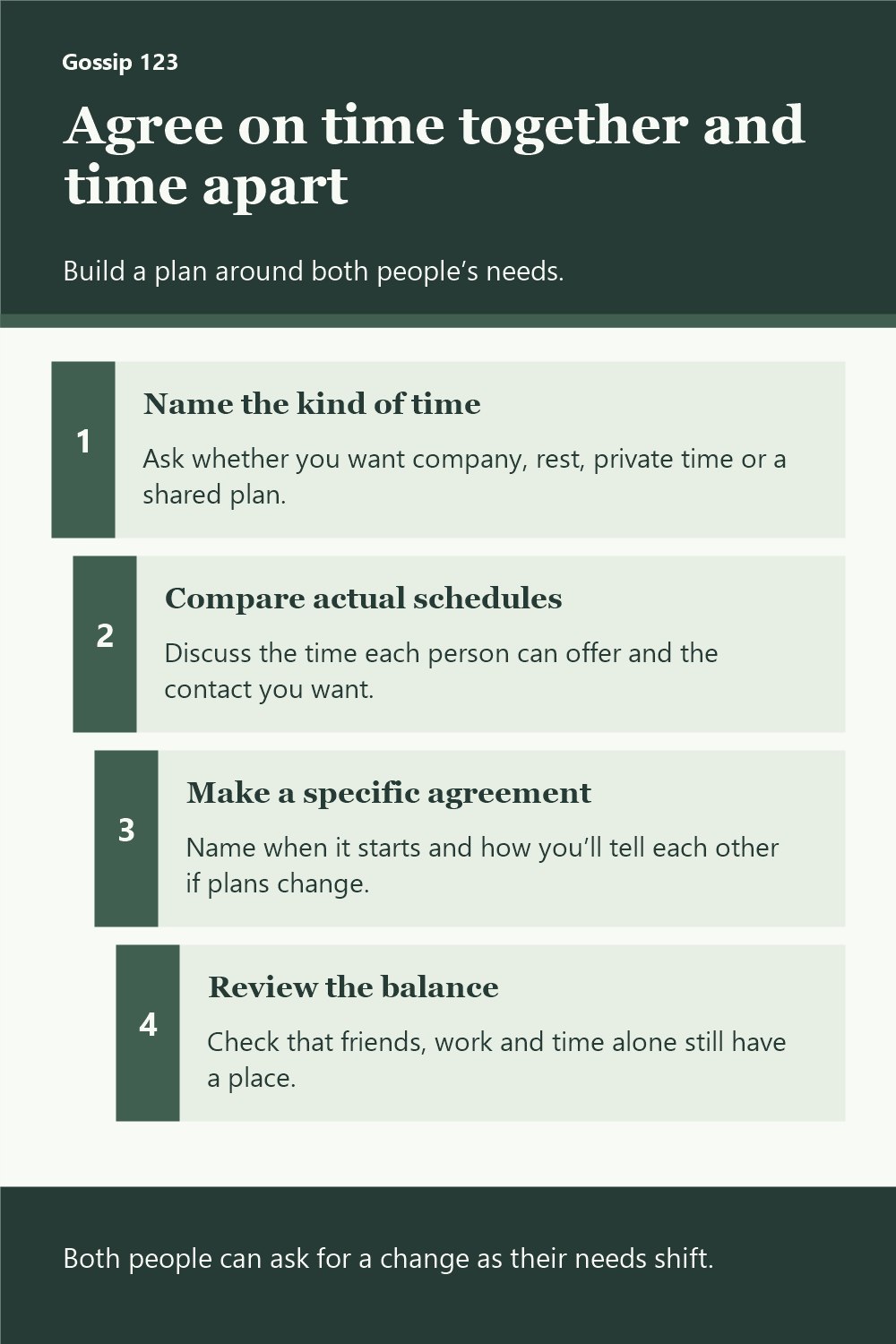
Agree on time together and time apart Build a plan around both people’s needs.
- Name the kind of time Ask whether you want company, rest, private time or a shared plan.
- Compare actual schedules Discuss the time each person can offer and the contact you want.
- Make a specific agreement Name when it starts and how you’ll tell each other if plans change.
- Review the balance Check that friends, work and time alone still have a place.
Both people can ask for a change as their needs shift.